SPACECRAFT MLI OUTER-LAYER MATERIAL
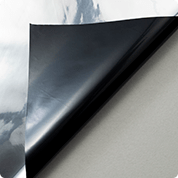
Aluminized Black Kapton® Film for MLI Outer Layers
Aluminized black Kapton® film is a
carbon-filled polyimide film with
vacuum-deposited aluminum on one side,
used most commonly as the outer layer
of spacecraft MLI blankets.
It operates from -250°C to 290°C at
25 µm thickness, with surface resistivity
of 105 to 107 Ω/sq
that dissipates surface charge, and a
black face that absorbs stray light
around optical instruments.
Thermal engineers specify it for charged
orbital environments and optical payloads
where a standard reflective outer layer
would cause problems.
10⁵–10⁷ Ω/sq
SURFACE RESISTIVITY
THICKNESS
25 µm
TEMPERATURE RANGE
-250°C to 290°C
SURFACE RESISTIVITY
10⁵–10⁷ Ω/sq
TYPICAL α/ε
1.1
01 / CHARGE DISSIPATION
Charge dissipation built into the film.
Polyimide alone is an electrical
insulator; the continuous carbon strands
in black Kapton® make the surface
dissipative at 10⁵ to 10⁷ Ω/sq,
bleeding off charged particles instead
of letting surface potential build.
02 / GROUND PATH
A ground path through the aluminum side.
The VDA layer provides a continuous
conductive path to spacecraft ground,
completing the charge-control scheme.
03 / OPTICAL CONTROL
Stray-light control for optical payloads.
The black face's high absorptivity
suppresses reflections around star
trackers, telescopes, and imaging
instruments.
04 / TEMPERATURE RANGE
A wide, cryogenic-to-hot service range.
-250°C to 290°C covers cryogenic
instruments and hot-side surfaces with
one qualified material.
MATERIAL PROPERTIES
What are aluminized black Kapton®'s specifications?
The film runs from -250°C to 290°C,
measures 25 µm thick, and holds surface
resistivity between 10⁵ and 10⁷ Ω/sq
with a typical outside-surface α/ε of
1.1.
|
Property
|
Value
|
|
Construction
|
Carbon-filled polyimide, VDA one side
|
|
Thickness
|
25 µm
|
|
Operating temperature
|
-250°C to 290°C
|
|
Surface resistivity
|
10⁵ to 10⁷ Ω/sq
|
|
Typical outside surface α/ε
|
1.1
|
APPLICATIONS
Where is aluminized black Kapton® film used?
The dominant use is the outer layer of
MLI blankets on satellites and
instruments, where the space-facing side
needs charge dissipation, stray-light
absorption, or both.
Programs insulating optical instruments
wrap the surrounding structure in black
Kapton® MLI to keep scattered light out
of the aperture.
In GEO and LEO charging environments it
forms the grounded outer skin of the
thermal blanket.
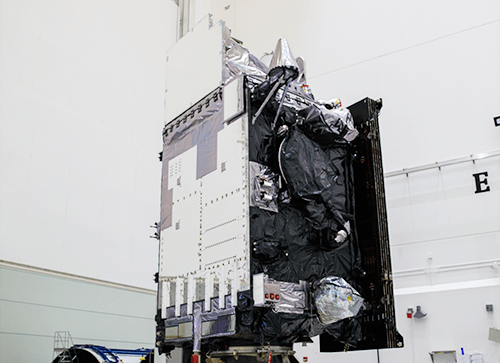
Satellite MLI —
Credit: NASA/Kim Shiflett
FLIGHT HERITAGE AND QUALITY
Decades of Spaceflight Material Experience
Dunmore Aerospace has manufactured thermal
control materials for the space industry
since 1985 from Bristol, Pennsylvania.
Dunmore materials flew on NASA's Cassini
mission, documented in NASA's Spinoff 2016
report.
Dunmore is ISO 9001:2015 certified.
1985
SPACE INDUSTRY
Aerospace thermal-control material experience.
Cassini
FLIGHT HERITAGE
Dunmore materials supported NASA's Cassini mission.
ISO
QUALITY SYSTEM
ISO 9001:2015 certified.
TECHNICAL FAQ
Aluminized Black Kapton® Film FAQ
Why use black Kapton® instead of standard Kapton® for an MLI outer layer?
Standard Kapton® is an electrical
insulator with a reflective
appearance; black Kapton® adds carbon
filler that makes the surface
charge-dissipative and optically
absorptive.
Choose black when the blanket needs
to bleed off charge or suppress stray
light.
How does the film dissipate electrostatic charge?
The carbon strands conduct charged
particles across the surface at
10⁵ to 10⁷ Ω/sq, and the aluminum
layer provides a continuous path to
spacecraft ground.
Charge drains instead of accumulating
to discharge-threatening potentials.
What temperature range does aluminized black Kapton® handle?
-250°C to 290°C, spanning cryogenic
instrument environments through hot
exterior surfaces.
What does an α/ε of 1.1 mean for thermal design?
The ratio of solar absorptance to
infrared emittance sets a surface's
equilibrium temperature in sunlight.
At 1.1 the black surface runs warmer
than a white or OSR surface; the
material is chosen for charge and
stray-light control rather than
cold-biasing.
Is it available in ready-to-integrate MLI kits?
Dunmore supplies MLI materials in
Satkit form, ready-to-use insulation
sets for spacecraft integration.
Contact Dunmore about outer-layer
configurations.
ALUMINIZED BLACK KAPTON®
Specify Your MLI Outer-Layer Material
Talk to Dunmore about aluminized black
Kapton® film for charge-dissipative MLI,
optical payloads, GEO and LEO spacecraft,
and ready-to-integrate insulation
configurations.
DuPont™ and Kapton® are trademarks or registered
trademarks of E.I. du Pont de Nemours and Company.