Passive heat rejection with no power draw.
Low solar absorptance and high emittance let the surface stay cold and radiate internal heat continuously, with no active cooling hardware.

DUN-COOL™ is a flexible thermal control film engineered to reject heat from spacecraft passively, combining low solar absorptance with high infrared emittance. It functions as a radiator surface or optical solar reflector (OSR), radiating internal heat to space while reflecting solar energy away from the vehicle. Satellite thermal engineers specify DUN-COOL™ where a spacecraft needs a passive cold surface in a flexible, conformable film.

Low solar absorptance and high emittance let the surface stay cold and radiate internal heat continuously, with no active cooling hardware.
The same material serves as a radiator surface or as an OSR, reducing the number of qualified materials a program has to carry.
Available perforated for venting and ease of installation, with options for increased atomic oxygen resistance, electrostatic discharge control, electrical through-conductivity, and protective coverlay.
DUN-COOL™ pairs low solar absorptance with high infrared emittance, the two properties that determine how cold a passive surface runs on orbit.
Full thermal property data is published in the DUN-COOL™ sell sheet.
View Full Thermal Data →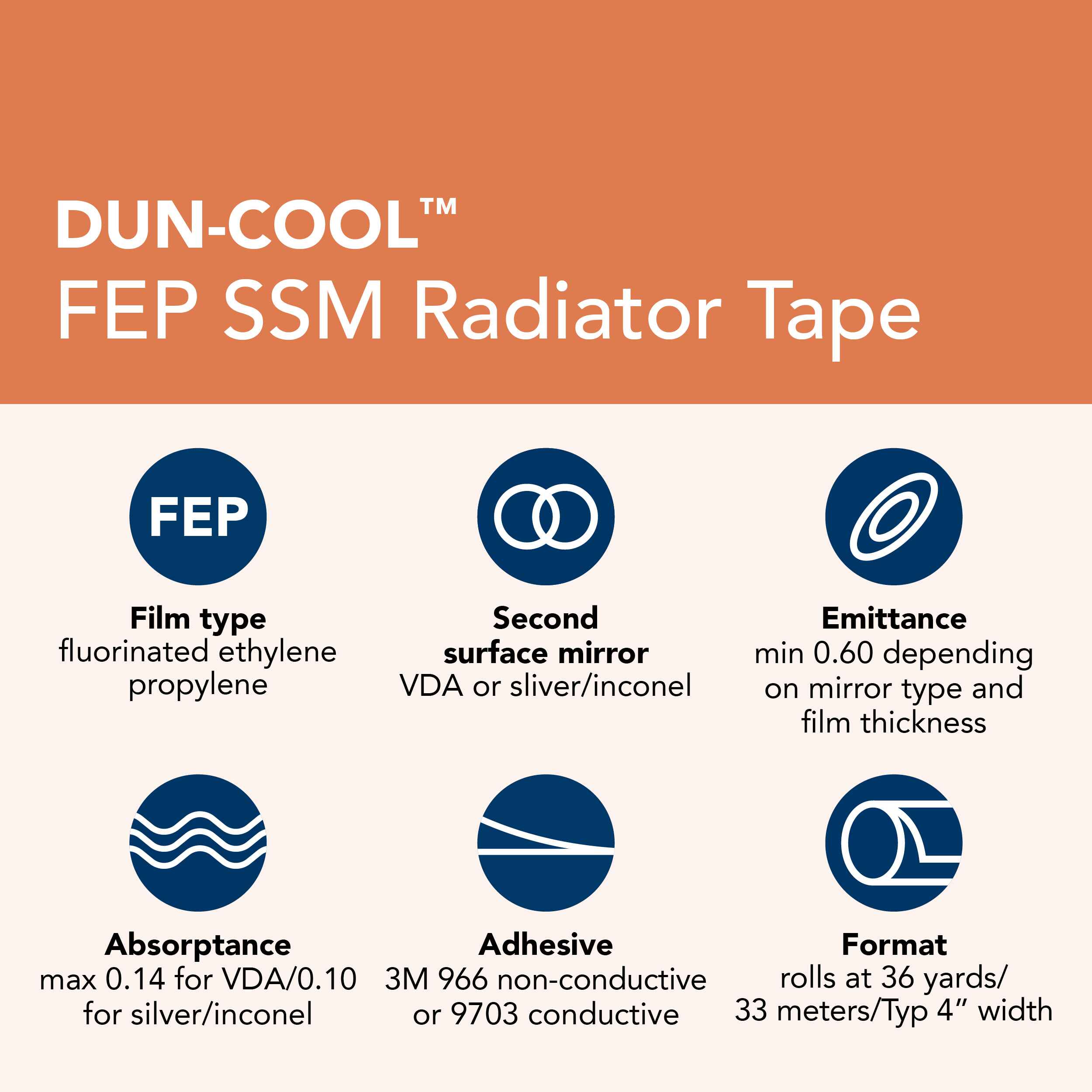
| Property | Value |
|---|---|
| Solar Absorptance (α) | Low |
| Infrared Emittance (ε) | High |
| Functions |
Radiator surface Optical Solar Reflector (OSR) |
| Options |
Perforated ATOX-resistant ESD Through-conductive Protective coverlay |
Spacecraft radiator surfaces reject heat from electronics, batteries, and payloads; DUN-COOL™ provides that radiating surface in a flexible, conformable film.
As an OSR it protects sun-facing exteriors on GEO and LEO spacecraft. The perforated and ATOX-resistant options target LEO vehicles, where atomic oxygen erodes exterior surfaces.
Dunmore Aerospace has manufactured thermal control materials for the space industry since 1985 from Bristol, Pennsylvania. Dunmore materials flew on NASA's Cassini mission, documented in NASA's Spinoff 2016 report. Dunmore is ISO 9001:2015 certified.
Supplying aerospace material solutions since 1985.
Dunmore materials supported NASA's Cassini mission.
ISO 9001:2015 certified.
An OSR is a spacecraft surface engineered to reflect most incoming solar radiation while emitting infrared heat efficiently, so the surface stays cold in direct sunlight. DUN-COOL™ performs this function as a flexible film.
Its low solar absorptance limits how much solar energy the surface takes in, while its high emittance radiates internal heat to space. The imbalance keeps the surface cold without powered cooling.
Standard metallized films reflect heat and serve as MLI layers, but are not optimized for the low-α/high-ε balance a radiator requires. DUN-COOL™ is engineered specifically for that radiator and OSR property set.
Dunmore offers DUN-COOL™ with an increased ATOX-resistance option for low Earth orbit, where atomic oxygen erodes unprotected polymer surfaces.
Yes. Options include electrostatic discharge control and electrical through-conductivity for charged orbital environments.
Contact Dunmore for DUN-COOL™ thermal property data, samples, configuration options, and application support for spacecraft radiator and optical solar reflector requirements.